
Does Invisalign Work for Adults? What to Expect From Start to Finish
Invisalign works reliably for adults with healthy gums and bone. Most adult cases finish in 12 to 18 months. The key variables are case complexity, your daily compliance, and whether refinement trays are needed at the end.
This guide walks you through the full process — from your first consultation to the night-only retainer routine that keeps your results permanent. It is designed for busy professionals and parents who want an honest look at results, costs, and timelines.
Prerequisites:
- Time for a consultation and digital scan
- Commitment to wear aligners 20 to 22 hours per day
- A travel hygiene kit for on-the-go wear
At Huelsman Family Dental, Dr. Kevin and Dr. Connor Huelsman use advanced scanning technology for precise treatment planning. This guide covers candidacy, gum health, how trays feel, and the reality of refinement periods. Visit our SureSmile and Invisalign page for more on local scheduling.

Step 1: Determine Your Candidacy for Invisalign
Before your first tray arrives, your mouth needs to be healthy enough for controlled tooth movement. Moving teeth through active gum disease or bone loss risks instability or tooth loss. Candidacy comes down to three factors:
- Periodontal stability: We screen for gum recession, bone loss, clenching, and existing crowns. Teeth move at any age, but they must stay within healthy bone to remain stable.
- Case complexity: Invisalign addresses crowding, spacing, and rotations. Severe bite issues may require traditional braces or a hybrid approach.
- Compliance: You must wear aligners for 22 hours per day to see results. This is non-negotiable.
Ask Dr. Huelsman these questions at your consultation:
- Is my periodontal health stable enough to move teeth safely?
- Do I need gum treatment before I start?
Step 2: Your Invisalign Consultation
Your first visit focuses on predictability and comfort. Huelsman Family Dental uses a Primescan digital scanner — no messy impressions, and the scan takes about 20 minutes less than traditional methods. Dr. Huelsman will review your goals, perform a clinical exam, and take digital x-rays or a 3D scan to map tooth movement.
Expect the appointment to last 45 to 60 minutes. You will receive a clear assessment of whether your case is mild, moderate, or complex. Pricing is based on your specific needs and insurance verification — not online averages.
You will leave knowing whether Invisalign or traditional braces better fit your goals. Ready to find out if Invisalign is right for you?
Step 3: Review Your Digital Treatment Plan
Before treatment starts, your dentist shares a digital projection of your tooth movements. This preview maps each tray’s specific goal so you know exactly what to expect. Note that the number of aligners in your first shipment rarely equals the total treatment time.
Ask these questions before approving your plan:
- What is the estimated time for the initial series?
- How often do refinements occur in similar cases, and are they included in the cost?
- Will I need attachments, elastics, or IPR (interproximal reduction)?
Most adult cases include a refinement phase. These extra trays perfect the final alignment and typically add 3 to 6 months to your plan. You are ready to proceed when you can clearly state the difference between your initial tray count and your total estimated timeline.
Step 4: Master Your Daily Compliance Routine
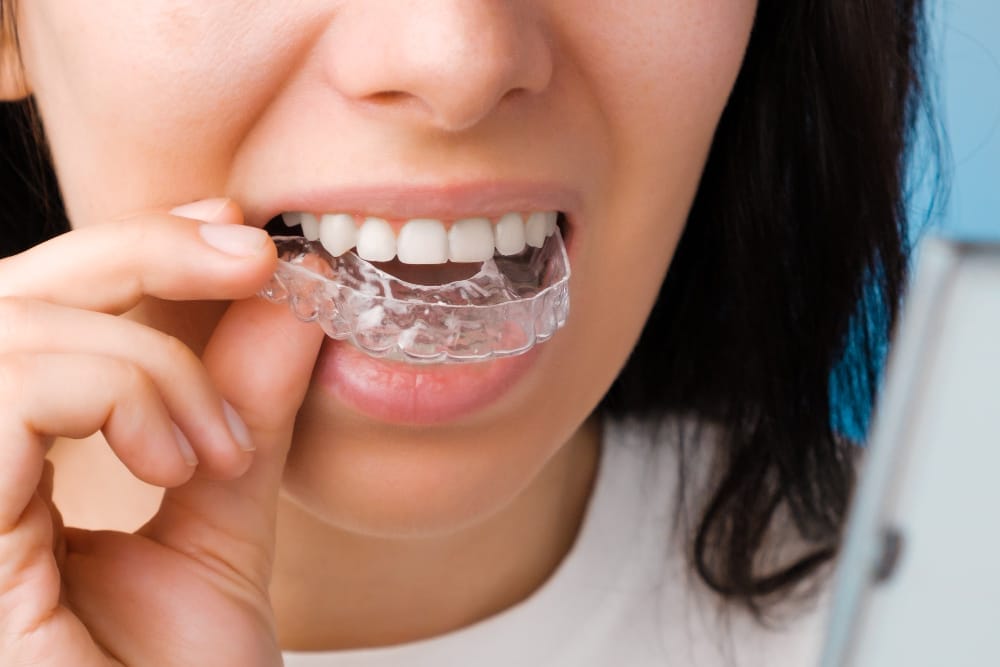
Firmly seat each new tray so the plastic applies the precise pressure required. The first 48 hours often determine whether Invisalign delivers the planned result.
Your dentist may apply tiny, tooth-colored attachments to provide leverage for specific movements. If one pops off, keep wearing your trays and call the Worthington office. Expect mild pressure and a temporary lisp during the first week. Practice speaking aloud before meetings to adapt quickly.
Follow this workday routine to maintain 20 to 22 hours of daily wear:
- Remove trays for all meals and snacks.
- Brush and floss before reinserting the aligners.
- Store aligners in their case. Never wrap them in a napkin.
Success check: You can outline a daily schedule that balances professional meetings with the 22-hour wear target.

Step 5: Monitor Progress and Prevent Delays
Many adults assume the aligners are working if they do not hurt. But “quiet failure” occurs when teeth fall behind the digital plan without discomfort. Regular check-ins at the Worthington office keep your treatment on schedule.
Watch for red flags:
- Air gaps at the tooth edge
- Inflamed or receding gums
- Cracked or lost trays
If a tray does not seat fully, contact us before moving to the next set. Avoid DIY fixes. We may advise extending wear time or returning to the previous tray.
Maintain hygiene baseline: Brush and floss before every reinsertion to prevent bacteria buildup under the trays.
Success check: You can name three signs of poor tracking and know to call us before switching trays.
Step 6: Finalize Your Smile and Protect Your Results
The last aligner is often followed by a refinement phase to perfect your results. This stage uses a new digital scan and a short set of extra trays to fix stubborn rotations or small gaps. Ideal results include straight teeth, closed gaps, and a stable bite that feels comfortable during daily function.
Retainers are non-negotiable for preventing relapse. Wear them full-time for three to six months before transitioning to night-only use. Once Dr. Huelsman removes your attachments, it is the ideal time for professional teeth whitening to complete your new smile.
Success check: You can explain the refinement process and describe the retainer routine that keeps teeth in position permanently.
Pro Tips for Managing Invisalign as a Busy Adult
Switch to new aligners at bedtime. You sleep through the initial soreness and wake up past the uncomfortable phase. Set recurring phone reminders after meals to avoid compliance lapses during the workday.
Limit snacking to main meal times. Frequent grazing is the top reason adult treatment timelines run long. Consolidating meals protects your 22-hour wear goal without disrupting your schedule.
Practice speaking aloud for five minutes daily to eliminate a temporary lisp. Changing trays on Friday evenings gives you the weekend to adapt before Monday meetings.
Keep a slim case and travel toothbrush in your bag or briefcase. Reinserting aligners over food particles is the fastest way to develop cavities during treatment.
Verify your adult orthodontic lifetime maximum separately from your standard dental coverage. This category is often distinct and can be combined with HSA or FSA funds to lower your out-of-pocket cost.
Frequently Asked Questions About Invisalign for Adults
Does Invisalign work for adults as well as it does for teens?
Yes. Teeth move predictably at any age if your gums and bone are healthy. Success depends primarily on wearing trays for 22 hours daily. Adults often have more complex dental histories than teens, which is why professional monitoring matters throughout the process.
How long does Invisalign take for adults?
Most cases finish within 12 to 18 months. Simple crowding can resolve in six months, while bite corrections take longer. Make sure your quoted timeline includes any refinement trays — additional sets often needed at the end to perfect the final alignment.
How much does Invisalign cost for adults?
Costs typically range from $3,000 to $7,000. Many insurance plans offer a lifetime orthodontic maximum, though some exclude adults. We recommend verifying your coverage before starting and using HSA or FSA funds to lower your out-of-pocket investment. Contact our office for a personalized quote.
Invisalign vs. braces for adults: which is better?
Invisalign is discreet and makes dental hygiene easier, which suits most professionals. Braces may be more efficient for severe rotations or complex bite shifts. The right choice depends on your specific case and your ability to commit to consistent wear.
Will Invisalign affect my speech at work?
A slight lisp is common during the first few days of a new tray. Practice speaking aloud at home to adapt quickly. Switching to new trays on Friday evenings gives your speech time to normalize before the workweek.
Can I use mail-order clear aligners instead?
Professional supervision is critical for protecting your bite and bone stability. Mail-order options lack the clinical oversight needed to prevent permanent damage or tooth loss. For a personalized recommendation, request a consultation with Dr. Huelsman.
Is Invisalign Right for You?
Invisalign works well for adults when the foundation is healthy and the compliance is consistent. The process takes 12 to 18 months for most cases, and the results last a lifetime with proper retainer use.
Dr. Kevin and Dr. Connor Huelsman have guided adult patientsthrough Invisalign® Near Westerville, Ohio, and throughout the Columbus area.Schedule a consultation to find out exactly what does Invisalign work for adults look like in your specific case.